

Last updated: November 2026
When is the SECP annual return due, and which form should your company file? Most private companies with a 30 June year end must file Form A, or the shorter Form 24, within 30 days of their AGM. If your AGM was on 28 October 2026, that deadline is 27 November 2026.
This checklist covers SECP annual return Form A filing in Pakistan from start to finish. It shows which form fits your company, how to count the days, what to prepare, and how to avoid the small errors that cause late fees. Use it now if your AGM is done. Keep it for next year if it isn't.
Prepared by the tax and corporate team at My Law Associates, Lahore, led by Mr. Faisal Mehmood, FPA, who has 17 years of experience in audit, corporate secretarial work and tax.
SECP Annual Return Form A Filing in Pakistan: Quick Answer
Most companies registered with SECP must file an annual return under Section 130 of the Companies Act 2017. File Form A within 30 days of your AGM if any details changed, or Form 24 if nothing changed. For an AGM held on 28 October 2026, the deadline is 27 November 2026. File Form 19 (UBO) with it.
Key takeaways
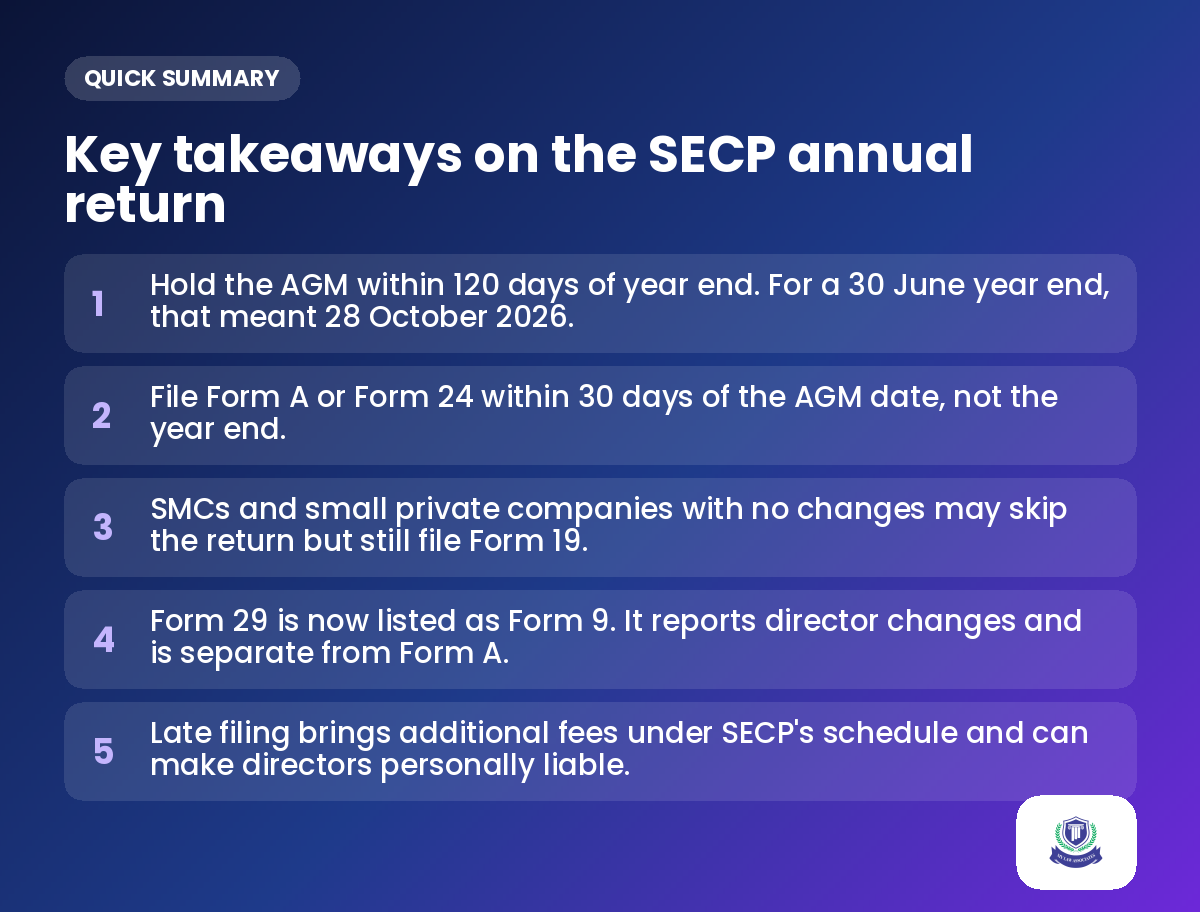
- The AGM must be held within 120 days of the financial year end.
- The 30-day filing window starts on the date of your AGM, not your year end.
- Single-member companies and private companies with paid-up capital of up to Rs 3 million may skip the return if nothing changed. They still file Form 19.
- Form 29 is now listed as Form 9 on SECP's forms page. It is a different filing from Form A.
- Late filing costs extra fees and can make directors personally liable.
What Is Form A in SECP?
Form A is the yearly annual return that tells SECP who runs and owns your company on the date of your AGM. SECP is the Securities and Exchange Commission of Pakistan, the government body that registers companies and checks that they follow the law.
What does the annual return contain?
It gives a snapshot of the company as of the AGM date. In plain terms, it covers:
- The registered office address
- Authorized and paid-up share capital (paid-up capital is the share money the owners have actually put in)
- The list of members (shareholders) and how many shares each one holds
- Directors, the CEO, the company secretary and the auditor, with their CNIC details
- Any share transfers during the year
Which law requires it?
Section 130 of the Companies Act 2017 requires the annual return. The Companies Act 2017 is the main law for running a company in Pakistan. The return goes to the Registrar of Companies, the SECP office that keeps each company's records. You can see the current form on the SECP statutory forms page.
Form A vs Form B
Companies with share capital file Form A. Companies without share capital, such as some NGOs and Section 42 organisations, file Form B instead. Nearly every private limited company and SMC has share capital, so Form A is the one most of our readers need.
What Is the Deadline for Filing the SECP Annual Return in 2026?
The deadline is 30 days after your AGM. For a company with a 30 June 2026 year end that held its AGM on the last allowed day, 28 October 2026, the return is due by 27 November 2026, as confirmed in the SECP reminder about the 27 November 2026 filing date.
The AGM comes first: within 120 days of year end
The AGM (Annual General Meeting) is the yearly meeting where shareholders see the accounts and choose directors. It must be held within 120 days of the financial year end. For a 30 June year end, that gave companies until 28 October 2026, according to the SECP advisory on AGMs and annual returns (APP, 6 Oct 2026).
Worked examples: counting 30 days from the AGM
Count from the actual date of your AGM. An earlier AGM means an earlier deadline. This mistake catches people every year.
| Date of AGM (2026) | Form A / Form 24 and Form 19 due by |
|---|---|
| 30 September | 30 October (already passed) |
| 15 October | 14 November |
| 28 October | 27 November |
These dates are general guidance based on the 30-day rule. Check your own AGM minutes for the exact date before you rely on any of them.
Is there an extension for private companies?
Private companies should not plan on an extension. Any extension of the filing date has historically been linked to listed companies, not private ones. Treat your 30-day window as fixed.
What if no AGM was held?
Skipping the AGM is a separate default under the law. It doesn't cancel the annual return. When no AGM is held, the due date is tied to the end of the calendar year instead. If your company missed its AGM, talk to a corporate adviser before filing so the dates and records line up.
Which Form Do I File: Form A, Form 24 or None?
File Form A if anything changed since your last annual return. File Form 24 if nothing changed. A few small companies can skip the return entirely, but they still owe Form 19.
Decision table
| Your situation | What to file | When |
|---|---|---|
| Company with share capital, details changed since last return | Form A + Form 19 | Within 30 days of the AGM |
| Company with share capital, nothing changed | Form 24 + Form 19 | Within 30 days of the AGM |
| SMC, or private company with paid-up capital up to Rs 3 million, nothing changed | No annual return; Form 19 only | Form 19 within 30 days after the calendar year ends |
| Company without share capital | Form B | Within 30 days of the AGM |
| A director, CEO or other officer changed during the year | Form 9 (formerly Form 29) | Within 15 days of the change |
The Rs 3 million and single-member exemption
Single-member companies and private companies with paid-up capital of not more than Rs 3 million don't have to file an annual return if their particulars haven't changed since the last return. This is in SECP's 2026 advisory. The key word is "changed." A new director, a share transfer or a new office address all count as changes. If any of these happened, the exemption is gone and you file Form A.
Form 19 still applies
Form 19 confirms that the company has checked who its real owners are. The real owner is called the Ultimate Beneficial Owner (UBO): the actual person who owns or controls the company, even if shares are held through someone else. Form 19 is filed with the annual return. If no annual return is required, it is due within 30 days after the end of the calendar year. In our experience, this is the form small companies forget most often, because they assume the exemption covers it. It doesn't.
Form 29 vs Form A: What Is the Difference?
Form A is a yearly snapshot filed after the AGM. Form 29 is an event-based form you file when a director or officer changes. SECP's forms page now lists the old Form 29 as Form 9, "Particulars of Directors and Officers."
Many websites still say "Form A and Form 29." That's why people get confused. The same thing happened to the old Form C, which is now Form 24.
| Point | Form A | Form 9 (old Form 29) |
|---|---|---|
| What triggers it | Holding the AGM each year | Any change of director, CEO, secretary or other officer |
| Deadline | 30 days after the AGM | 15 days after the change |
| How often | Once a year | Every time a change happens |
| What it shows | Full picture of members, capital and officers | Only the officer change |
A practical tip: file any pending Form 9 before Form A. If SECP's records still show an old director, your Form A won't match the register. That mismatch is where delays start.
Stage 1 Checklist: Before You File
Get your records straight before you open the portal. Most filing problems come from data that doesn't match SECP's records, not from the portal itself.
- Confirm the exact AGM date from the signed minutes.
- Write down your deadline: AGM date plus 30 days. Set a phone reminder a week earlier.
- Check whether anything changed since last year's return. Decide: Form A, Form 24 or exempt.
- File any pending Form 9 for director or officer changes.
- Update the register of members. Match each shareholder's name and CNIC to their card.
- Check share capital figures against your last return and any new share issue.
- Confirm the current auditor, CEO and company secretary details.
- Complete UBO checks: send notices to members, collect their declarations, and update the UBO register.
- Keep the approved financial statements for the year at hand. Shareholders see these at the AGM.
- Make sure you can log in to the company's SECP account, and that the registered mobile number and email still work.
Stage 2 Checklist: How Do I File Form A on the SECP Portal?
You file online through SECP's portal. SECP's October 2026 reminder points companies to leap.secp.gov.pk. Older pages may call it eZfile or eServices. Screens can change, so follow what the portal shows. The order below is the safe one.
- Log in to the SECP portal with the company's user account.
- Select your company and open the annual return form (Form A, or Form 24 if nothing changed).
- Enter or review the AGM date. Double-check it, because it drives every date after it.
- Review the pre-filled members, share capital and officer details. Correct anything that differs from your register.
- Prepare Form 19 (UBO declaration) so it goes in with the return.
- Pay the government filing fee online or through the challan (payment slip) the portal generates.
- Submit using the verification the portal asks for, such as a PIN or a code sent to the registered user.
- Download and save the acknowledgement or receipt.
If the portal gives an error you can't solve, SECP lists an eZfile query helpline: 051-9195307.
A privacy note. Use only official SECP portals. Never share your company login or one-time codes with anyone you don't fully trust. Share CNIC copies only with your own adviser. Our team works with a privacy-first approach for exactly this reason.
Stage 3 Checklist: After You File
Filing isn't finished until you can prove it. Keep a clean record for next year and for any SECP query.
- Save the filing acknowledgement and fee receipt as PDFs in one company folder.
- Keep a copy of the filed Form A or Form 24 and Form 19.
- File the AGM minutes, UBO declarations and updated registers with them.
- Check the portal a few days later to see the filing status.
- Note next year's AGM deadline in your calendar today.
What to Check, Why It Matters, and Red Flags
This table lists the checks we run on every annual return before it goes to SECP. Each red flag is a common reason a filing goes wrong.
| What to check | Why it matters | Red flag |
|---|---|---|
| AGM date | The 30-day deadline is counted from it | Counting 30 days from 30 June instead of from the AGM |
| Form choice | Form A and Form 24 serve different cases | Filing Form 24 when a share transfer happened |
| Pending officer changes | Form A must match SECP's officer records | A director left but Form 9 was never filed |
| Shareholder CNICs | Names and numbers must match official records | Spelling or CNIC digits differ from the card |
| Share capital | Paid-up capital must match past filings | Numbers differ from last year with no new share issue |
| Form 19 (UBO) | It is required even for exempt companies | Assuming the Rs 3 million exemption covers it |
| Auditor and CEO details | Outdated details make the return inaccurate | Last year's auditor still listed after a change |
| Portal access | Codes go to the registered user | Registered mobile number no longer in use |
What Happens If You File the SECP Annual Return Late?
A late annual return with SECP brings additional fees under SECP's fee schedule, and directors and officers can be held personally liable. Companies that keep missing filings also risk being treated as defaulters and, in the worst case, being struck off the register.
Additional fees and director liability
We aren't quoting a penalty figure here, and we suggest you're careful with sites that do. The late-fee numbers published on different websites don't agree with each other, and we haven't found one official SECP figure to confirm them. The portal calculates the additional fee when you file. What's certain is that the cost grows the longer you wait, and responsibility sits with the directors and officers, not just the company.
Strike-off risk
Strike-off means SECP removes a company from its register. That usually follows repeated defaults over time, not one late form. Even so, a defaulter record can cause trouble when you open bank accounts, apply for tenders or need SECP approvals later.
How to fix a missed deadline
- File as soon as you can. Waiting only adds cost.
- Clear any pending Form 9 first, so your return matches SECP's records.
- If several years are missing, file them in order, oldest first.
- Pay the additional fee the portal shows.
- Keep every receipt in case SECP sends a notice.
Backlog years are where professional help pays off most. Our company law services for Form A, Form 9 and share transfers cover catch-up filings for companies that have fallen behind.
SECP Annual Compliance Checklist: Calendar for a 30 June Year End
For a private limited company with a 30 June year end, the yearly cycle runs from year end, to AGM, to annual return. The dates below apply to the 2026 cycle.
| When | What to do | Filed with |
|---|---|---|
| 30 June 2026 | Financial year ends; close the books and start the audit | Internal |
| By 28 October 2026 | Hold the AGM (within 120 days of year end) | Internal; minutes kept |
| Within 15 days of any officer change | File Form 9 (formerly Form 29) | SECP |
| Within 30 days of the AGM (27 November 2026 for a 28 October AGM) | File Form A or Form 24, plus Form 19 | SECP |
| Within 30 days after 31 December 2026 | Form 19 only, if no annual return was required | SECP |
| As per the latest FBR notification | Income tax return for Tax Year 2026 | FBR, through IRIS |
Is the SECP annual return the same as the FBR income tax return?
No. The annual return tells SECP who owns and runs the company. The income tax return tells FBR (Federal Board of Revenue) about income and tax, and it is filed on IRIS, FBR's online portal. Filing one does not cover the other. If you need the tax side handled too, see our income tax return and filer services for companies.
Can I File It Myself or Should I Hire a Professional?
You can file it yourself if your company is simple and your records are current. Get help when there are changes, missing years or UBO questions.
When self-filing works
- One or two shareholders, and nothing changed this year
- All previous returns filed on time
- You have working portal access and your registers are up to date
When to get help from My Law Associates in Lahore
- Several changes this year: new directors, share transfers or a capital increase
- One or more years of returns not filed
- UBO registers and declarations never set up
- An SECP notice already received
- Converting an SMC to a private limited company
Since 2010, our team of more than 25 professionals has served more than 130 client organizations in sectors such as energy, IT, trading, manufacturing and construction. We handle the corporate side and the tax side together, which saves directors from chasing two separate firms. You can browse all our tax, corporate and registration services, or ask about FBR matters through our tax services.
Printable Summary: Annual Return Checklist on One Page
Print this list or save it to your phone. Tick each line before you press submit.
- ☐ AGM held within 120 days of year end; exact date noted
- ☐ Deadline written down: AGM date + 30 days
- ☐ Form chosen: A (changes), 24 (no changes), B (no share capital) or exempt
- ☐ Any officer change filed on Form 9 first
- ☐ Shareholder names and CNICs match the register
- ☐ Share capital matches past filings
- ☐ UBO declarations collected and register updated
- ☐ Form 19 ready to file with the return
- ☐ Portal login and registered mobile number working
- ☐ Fee paid and acknowledgement saved
- ☐ Next year's AGM date added to the calendar
Frequently Asked Questions
What is Form A in SECP?
Form A is the annual return a company with share capital files with SECP each year. It lists the company's members, share capital, directors and officers as of the AGM date, and it is required under Section 130 of the Companies Act 2017.
What is the deadline for filing the SECP annual return in 2026?
It is 30 days after your AGM. For companies that held their AGM on 28 October 2026, the deadline is 27 November 2026. An earlier AGM means an earlier deadline.
Is Form A mandatory for a single-member company?
Only if something changed. A single-member company with no change in particulars since its last return doesn't have to file an annual return. It must still file Form 19.
When do I file Form 24 instead of Form A?
File Form 24 when nothing has changed since your last annual return. If any detail changed, such as a director, shareholder or address, file Form A instead.
What is the penalty for late filing of the SECP annual return?
Late filing brings additional fees under SECP's fee schedule, and directors can be held liable. Figures on different websites conflict, so check the fee shown on the portal or ask us. Repeated defaults can lead to strike-off.
What is Form 19, and do I file it with the annual return?
Yes, Form 19 goes with the annual return. It confirms that the company has identified its real owners (UBOs). If no annual return is required, file Form 19 within 30 days after the calendar year ends.
Is the SECP annual return the same as the FBR income tax return?
No, they are separate filings. The annual return goes to SECP. The income tax return goes to FBR through IRIS, and each has its own deadline.
Need Help With Your Annual Return?
If your deadline is close, or you aren't sure which